Journal · 2026-09-01 · 16 min
Force changes what is wrong and where
Force in a loaded, perfused periodontium changes the biochemical environment of the millimetre gap, that environment changes the signal, and the signal relocates what is wrong and where.
Igor Kosmina, DMD · Polyclinic Breyer, Sisak · Consultations for a fee
The short definition lives at /periomechanics. The essay form of the name is what PerioMechanics is. This note is neither. It is the loop those pages are pointing at.
I work at Polyclinic Breyer in Sisak. Consultations for a fee. I am not listing biomechanics, tissue architecture, tissue engineering, and signal modifications as four search terms. I am writing why they are one cycle in a mouth that will occlude tomorrow morning.
The periodontium is a load-bearing, perfused organ. That sentence is already on the site. The next sentence is the one most of our teaching still skips: force does not only move a tooth a few micrometres. Force changes the chemistry of the gap. The chemistry changes what the cells hear. What the cells hear changes the organ. The next load meets a different construction.
That is the whole note. The rest is the loop, walked slowly.
Tooth and bone barely move. The gap does the work.
Tooth is stiff. Bone is stiff. Compared with those two, the periodontal ligament is a thin, fiber-reinforced, fluid-filled gap. Thin is not a defect of the design. Thin is the point.
Stress concentrates where stiffness drops. Fluid pressure concentrates where the volume is small and the walls are hard. If you want to know where bite becomes biology, you look at the fraction of a millimetre between two barely movable solids. Teaching numbers, not a device output: the living ligament is a few tenths of a millimetre thick. That is enough room for fibers, fluid, and a vascular plexus. The gap is the organ's working space.
Anisotropy is not a modelling flourish. Tooth, PDL, bone, and gingiva are not one material. They do not share a modulus, a permeability, or a blood supply. A load that is kind to an axial fiber network can be rude to a crestal plate. The PDL is reasonably good at turning an axial vector into a distributed compressive field. It is less forgiving of a shear component that leverages the crest. I already wrote that as architecture and as attachment. Here I need the smaller claim: the same vector is a different problem in the gap than it is in the bone, because the materials are different and the gap is thin.
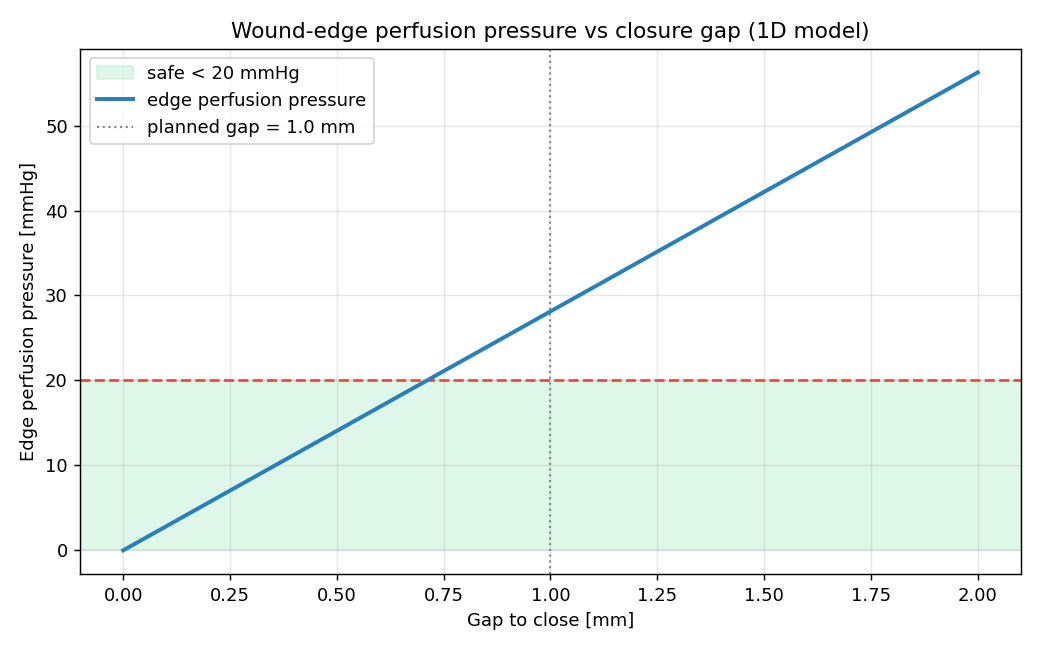
Gap versus edge pressure. Teaching sketch. Not a medical device. Not for diagnosis.
A dry spring in that gap is a first-year sketch. The clinic is not a first-year sketch. The ligament drinks. Fibers and fluid share the short timescale. Rapid loading raises interstitial pressure before the fluid has somewhere to go. Slow loading lets the bed drain and looks, falsely, like a simpler solid. If you model the gap as rubber, you have already discarded the member that carries both load and blood.
The periodontium as architecture is the chair-scale construction. The ordered plates start at the lab. The knobs for axial versus oblique, perfusion on or off, sit on simulate. How a sketch becomes a mesh is clinical sketch to FEA. I will not redo a von Mises caption. Colour on a teaching plate is not a diagnosis. It is a way of pointing at the gap.
Architecture is what makes that loop possible.
I am not writing another wall-count essay. Walls, poles, and millimetres of papilla live in the chair notes: the architect, how an attachment lasts, mucogingival geometry. This note stays at the organ.
Architecture here means the construction that lets the loop run at all. PDL width. Fiber orientation along the root. A vascular plexus packed into those same millimetres. Four tissues as a composite, not as wallpaper around a post.
The width of the gap is a design parameter. Too wide and the tooth is a passenger. Too narrow and the fluid has nowhere to go, the fibers have no excursion, the vessels are pinched. The living range is narrow because the job is narrow: turn bite into a distributed field without starving the bed. Width also varies along the root. A model that paints one thickness on a cylinder has already averaged away the places the clinic actually fails.
Fiber orientation is the anisotropy you can see with a stain. Oblique fibers are a machine for axial load. They are a worse machine for a lateral component at the crest. Cementum is the interface the fibers insert into. Cortical plate and cancellous core take what the ligament hands them, and they do not take it the same way. That is not a personality of "the gum." It is a fiber direction in a thin gap, glued to two mineralized tissues that are not one bone.
Blood is a member of that composite. Not a caption under a histology slide. The plexus lives in the same millimetres as the fibers. When the gap is compressed, the plexus is compressed. When a papilla goes white, the construction just lost a member. Colour is the report. I will not spend this page on stitch arithmetic. That note is already written.
Four materials. One load path. A vascular bed in the working gap. That is the architecture that makes biochemistry and signaling possible, because both of those happen in a place, and the place is this construction. Remove a member and the loop does not pause. It reroutes. Compensation is not the same as health.
Out of that mechanics comes a biochemical environment.
This is the sentence the definition already uses. I am going to unpack it, not repeat it.
A loaded gap is not a dry room. Interstitial pressure rises. Fluid is displaced. If drainage is slow relative to the bite, pressure stays high for a while after the teeth have left each other. Vessels in that volume see a transmural pressure they did not choose. Perfusion drops. Glucose delivery drops. Local pO2 drops. Metabolites sit. pH drifts. The ligament you assigned a modulus to last week is now a different soup.
The clocks are not the same. Bite is milliseconds to a second. Drainage is longer. A blanched papilla is minutes. Cell programs run on hours and days. Matrix remodeling is weeks to years. If you freeze one clock and call it the organ, you will plan as if the others had stopped.
A dry ligament is a different material. That is the teaching toggle on this site, and it is also the chair. Perfusion is not a footnote. The graft version of the same physics, distance from a perfused face, glucose before oxygen, is the graft survives on glucose. I will not rewrite either. I need them here as the environment the gap actually has.
Pathology writes the same environment without asking you for a new restoration. A pocket is a different gap: more fluid, a disrupted fiber net, a different metabolite load, a bed that may still look like attachment on a radiograph. Inflammation is not a mood around the organ. It is a change inside the working space. The biochemical environment is not a chapter that starts after the mechanics lecture. It is what the mechanics does to a perfused, thin, fiber-reinforced gap. If you skip that, signaling will sound like a biology module you can paste on later. It is not.
The signal relocates what is wrong and where.
This is the hole.
Cells in the gap do not read newtons. They do not read a heatmap. They read stretch, hydrostatic pressure, oxygen, glucose, pH, and the chemical conversation of their neighbours. Mechanotransduction is that translation: load to cell to matrix. It is downstream of anisotropy and perfusion. It is not a separate biology chapter you open after you have done the mechanics.
Two field directions are enough. I will not invent a paper, and I will not paste a pathway laundry list.
First: load to cell to matrix remodeling. A repeated stretch in a well-perfused, well-oriented fiber net is a signal to maintain or adapt the net. A repeated shear at a crestal plate, or a compression that empties the fluid and pinches the plexus, is a different signal in the same millimetres. Bone facing that gap sees a different strain and a different fluid pulse. Osteocytes live on that pulse. Fibroblasts in the ligament live on stretch and on whether the bed is still fed. The matrix that is laid down, or taken away, is the organ answering the vector.
Orthodontic movement is the public version of this sentence. A controlled load. A changed environment in the gap. A signal. A relocation of bone. Periodontitis is the uninvited version. The vector may be ordinary breakfast. The gap is not ordinary. The signal still relocates tissue. We just prefer to call that pathology, as if pathology were a different physics.
Second: inflammation changing constitutive behaviour. How an attachment lasts already said it. Inflammation changes the material we assigned to "attachment" last week. Here is how, still in chair language.
An inflamed ligament is wetter, more cellular, less a fiber machine. Collagen is being turned over faster than it is being aimed. Vascular permeability is up, so interstitial pressure is no longer the pressure you assumed for a healthy gap. The same newton now produces a different stress, because the stiffness, the permeability, and the fluid are different. Immune cells are now part of the conversation the resident cells hear. The signal is not only stretch. It is stretch plus a chemical environment that tells cells to resorb, to recruit, to stop making the fiber you were counting on.
A compressed, under-perfused, inflamed gap is not three problems. It is one environment. The molecular signaling in that environment decides what leaves and what stays. I will not name a cytokine alphabet. The chair already knows the direction. An inflamed attachment is a different material. The same vector on that material is a different surgery.
Then the output relocates. Bone does not leave at random. Attachment does not migrate as a mood. The "where" of the lesion is the map of this loop: which millimetres of gap saw which combination of vector, pressure, perfusion, and inflammatory conversation, for how long. A furcation concentrates that map. A thin buccal plate has less to lose when the signal says leave. Pictures of the map, for a patient door, are what periodontitis is and why gums recede. This note is why the map is not a sticker you put on a tooth.
And then the loop closes on itself. The material has changed. The architecture has changed: a thinner plate, a wider gap in one place, a narrower one in another, a fiber net that no longer matches last year's orientation. The biochemical environment of the new gap is not the old one. The next load, even if the patient bites the same, meets a different organ. Force changes what is wrong and where. Then where is wrong changes what the next force does.
That is not a slogan. It is why a static picture of "the defect" is already late. The defect is an output, and the next input.
A construct is asked to enter the same loop.
Tissue engineering, in this mouth, is not a fifth specialty. It is the moment you put a construct into the cycle and ask it to become organ.
GTR, a living soft-tissue wall, a graft, forced eruption: one family. Not one kit. A container. Perfused faces. A signal that cannot substitute for space. A load the construct will inherit tomorrow morning.
I already wrote the table and the tent. A flat ridge is not a cup. Enamel matrix derivative can signal. It cannot hold vertical space alone. One sentence is enough; the rest is in that note.
Forced eruption is the named, slow member of the same family. Move the tooth, and sometimes the apparatus comes with it. You are stealing a container from a position the tooth used to occupy. You are also writing a load history into the gap on purpose. That is tissue engineering by vector. It is not a weekend protocol, and it is not an algorithm I am handing you.
A living wall is still a wall: it has to be perfused, it has to be stable, it has to not go white. A graft is a volume that must drink from faces that actually exist. GTR is a fence in a race epithelium always wants to win, inside a container that may or may not exist. None of these is a product story. Each is a request that a volume join the same loop the native gap already runs: mechanics, environment, signal, a changed construction, the next load.
Lab 05 is the constraint map: regenerative constraint. Geometry first. Load second. Then you may pick a membrane, a graft, a biologic. Those choices matter. They are not the first choice, and they are not a ranking. A collagen sheet that drapes onto a table is not an architecture. A signal poured into a volume the blood cannot reach is a rumour. A beautiful regenerate that inherits an unchanged oblique vector is biology asked to outrun mechanics until it does not.
The construct does not get a holiday from the loop. Once it is in the gap, or next to it, it sees interstitial pressure, perfusion, metabolites, and the next meal. If you planned only the photograph of day zero, you planned a still. The organ is a cycle.
Four words, one cycle under bite.
Biomechanics. Tissue architecture. Tissue engineering. Signal modifications.
They look like four headings because that is how catalogues are written. They belong together because they are one cycle. Architecture is the construction. Biomechanics is what bite does in the thin gap of that construction. Out of that mechanics comes a biochemical environment. Signaling is how the cells in that environment relocate what is wrong and where, and how the organ that meets the next load is not the organ you charted last year. Tissue engineering is the request that a construct join the cycle and become that organ, or a piece of it.
Split them and you get four incomplete plans. A mechanical model that never drinks. An architecture lecture that never meets a vector. A biologic poured into a volume with no tent and no bed. A signaling story that starts after "the mechanics" as if cells lived somewhere else. The mouth does not split them. Breakfast does not split them.
PerioMechanics is first-principles periodontology. The short definition is at /periomechanics. This note is the loop inside the name.
I work at a chair in Sisak. The patient in front of you still needs your chart. Teaching models on this site are not a device and not a diagnosis. If the force, the gap, the blood, and the signal still disagree, say so before you open. The four words will not save a table, and they will not replace a vector. They will stop you treating them as four stories.
Force changes what is wrong and where. That is the system.