Journal · 2026-08-31 · 8 min
How an attachment lasts
An attachment lasts if the load, the blood, and the geometry still agree after years. That is a chair sentence, not a wellness slogan.
Igor Kosmina, DMD · Polyclinic Breyer, Sisak · Consultations for a fee
I am not writing a promise about how long a mouth will live. I am writing how an attachment stays an attachment.
I work at Polyclinic Breyer in Sisak, and freelance. I do not need a new word for ageing. I need colleagues to stop treating years as a brand and start treating them as load, blood, and a measured corridor.
The corridor
Gargiulo, Wentz and Orban (1961) measured the dentogingival junction. Sulcus, epithelial attachment, connective-tissue attachment. The last two are what later teaching called biological width: on the order of two millimetres as a mean in that series. A mean is not a patient. It is a reminder that the attachment occupies a measured corridor, not a mood.
Violate the corridor with a margin, a restoration, or a vector that keeps the tissue in tension, and the attachment does not argue. It recedes or it inflames. That is not a forecast of a life. It is a local geometry that failed.
The patient walkthrough of what happens when bone is asked to leave is on periodontitis. This note is the colleague version: the attachment is a construction that has to keep working.
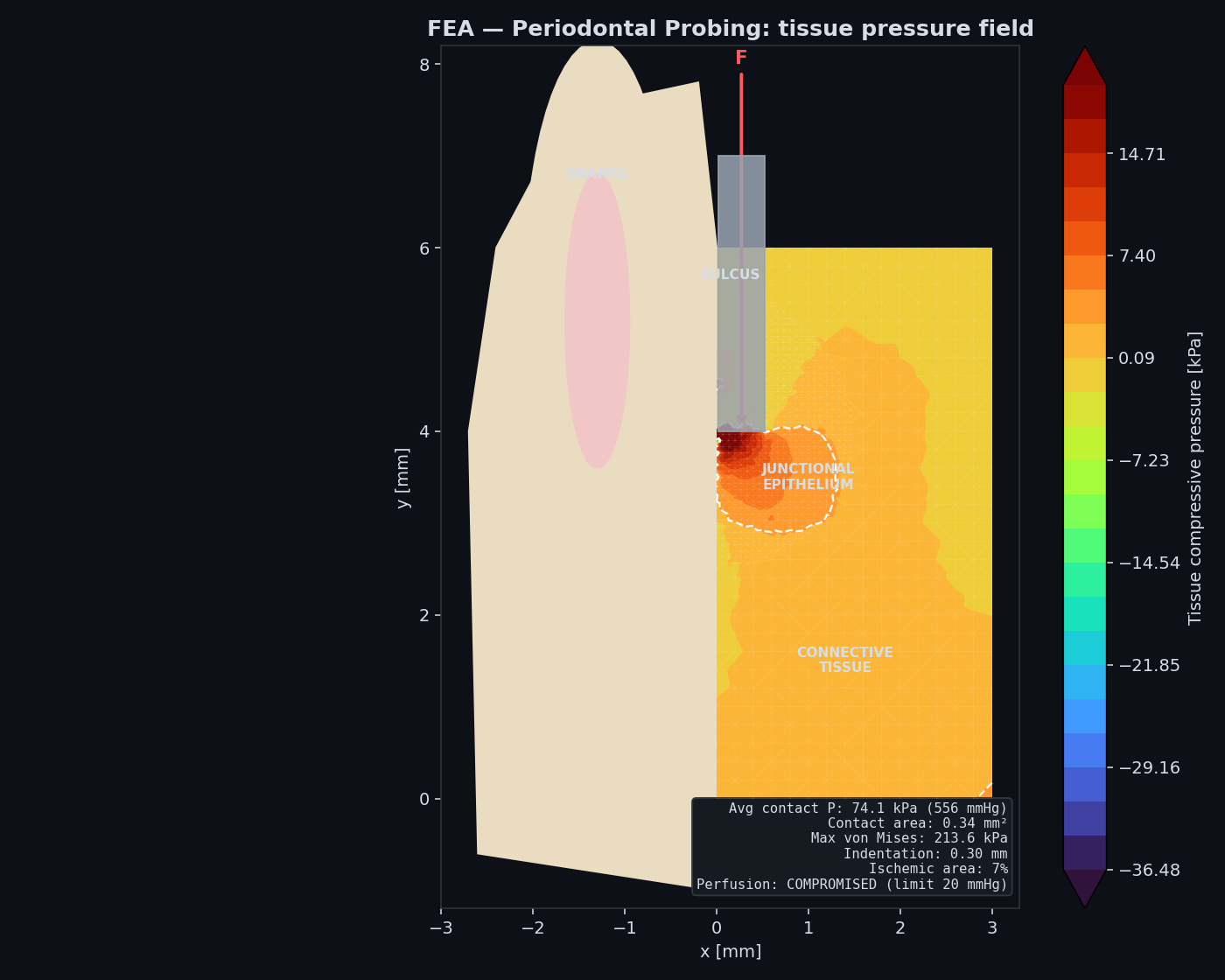
Probing pressure field. Teaching FEA overlay. Not a medical device. Not for diagnosis.
Load over years
Occlusal force is a vector. It has a point of application, a magnitude, and an angle relative to the long axis. The PDL is reasonably good at turning axial load into a distributed compressive field. It is much less forgiving of a shear component that leverages the crest.
A high restoration, a cantilever, group function on a thin buccal plate: these are the same statics problem billed as different specialties. Magnitude without direction is an incomplete load. Most attachments I have watched fail were not asked for too many newtons in one sitting. They were asked for the wrong angle, every meal, for years.
The teaching knobs for that sentence are on simulate. Axial versus oblique. Perfusion on or off. The magnitudes are illustrative. The direction is the lesson. It is not a device output. It is not a forecast of how long a given tooth will last.
A regenerated wall inherits the same vector. If you rebuild geometry and leave the resultant pointing at the crest, biology is being asked to outrun mechanics until it does not. The lab plate is occlusal vectors.
Blood is the material
A ligament that cannot perfuse is a ligament whose constitutive behaviour you no longer know. Inflammation changes the material we assigned to "attachment" last week. A blanched papilla is a perfusion event with a mechanical cause. A compressed PDL is the same event one millimetre deeper.
Bone lives near a capillary. Teaching literature puts vascular ingrowth in the neighbourhood of half a millimetre a day. That is a field constant for how far a healing front can be asked to wait. It is not a number from my theatre. Distance from a perfused face is still the variable you can change.
Years of a clean, well-loaded, well-perfused corridor are how an attachment lasts. Years of an oblique vector on an unperfused slope are how it does not. I will not dress that as a programme. I will not invent a trial percentage for "lasting."
What I am not saying
This is teaching. It is not a certified device output. It is not a promise of how long a tooth, a graft, or a person will last. The FEA plates are overlays on a teaching geometry. They are not patient-specific diagnosis.
If you wanted the ordered plates — system, perfusion, vectors — start at the lab. The patient door is periodontitis. The knobs are on simulate. Name the load. Name the blood. Name the corridor. Then decide whether the attachment you are looking at can still do the job.
How an attachment lasts is not a slogan. It is whether those three still agree.